





























Research Scholar from GNDU Represents India at 26th Tetrahedron Symposium 2026 in Shenzhen, China

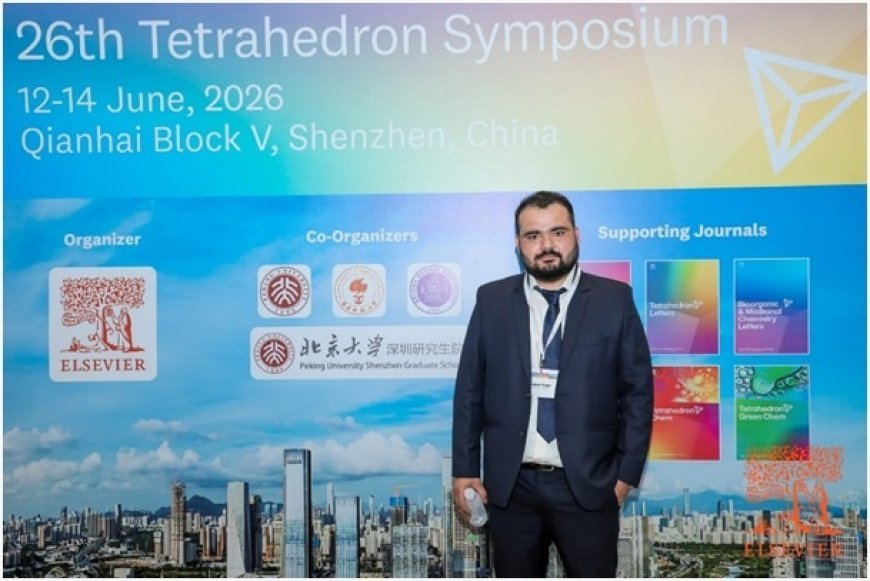
AMRITSAR: Karanvir Singh, a Research Scholar pursuing his Ph.D. under the supervision of Prof. Preet Mohinder Singh Bedi at the Department of Pharmaceutical Sciences, Guru Nanak Dev University, proudly represented India at the prestigious 26th Tetrahedron Symposium 2026, held in Shenzhen, China. The symposium, organized by Elsevier, brought together eminent scientists, researchers, and academicians from across the globe to discuss recent advances in medicinal chemistry and allied sciences. Participation in this internationally renowned scientific event provided an excellent platform to interact with leading researchers, exchange scientific ideas, and gain exposure to cutting-edge developments in medicinal chemistry and drug discovery.
During the symposium, Karanvir Singh presented a scientific poster entitled “Design, Synthesis, and Biological Evaluation of Triazole-Linked Lignan-Monoterpenoid-Based Hybrid Molecules as Xanthine Oxidase Inhibitors with Potent In Vivo Efficacy.” The research attracted considerable interest from international delegates and highlighted ongoing efforts toward the development of novel therapeutic agents for the management of hyperuricemia and related disorders. Uric acid is the final product of purine metabolism in humans, and elevated uric acid levels, a condition known as hyperuricemia, have emerged as a significant global health concern.
Persistent hyperuricemia can lead to gout, kidney dysfunction, cardiovascular complications, and metabolic disorders. Xanthine oxidase, a key enzyme involved in uric acid production, has therefore become an important therapeutic target for the treatment of these conditions. The research laboratory of Prof. Preet Mohinder Singh Bedi has been continuously engaged in the design and development of novel bioactive molecules, aimed at regulating uric acid levels through xanthine oxidase inhibition. The laboratory has been actively exploring innovative molecular hybrids and natural product-inspired scaffolds to identify safer and more effective therapeutic candidates with improved biological efficacy. The presented work represents one of the significant outcomes of these ongoing research efforts.
The visit to China was financially supported by the Anusandhan National Research Foundation (ANRF), Government of India, under its International Travel Support scheme, which promotes international scientific collaboration and encourages young researchers to participate in global academic events. Expressing his gratitude, Karanvir Singh sincerely thanked the ANRF, Government of India, for providing financial assistance that made participation in the symposium possible. He also expressed heartfelt appreciation to his research supervisor, Prof. Preet Mohinder Singh Bedi, for his continuous guidance, encouragement, and mentorship throughout his doctoral journey.
Furthermore, he extended his sincere thanks to Vice Chancellor, Guru Nanak Dev University, Amritsar, for providing an enriching academic environment and unwavering institutional support that enabled him to represent the university on an international platform. Such achievements highlight the growing international presence of GNDU researchers and reflect the university’s commitment to excellence in research, innovation, and global scientific engagement. The successful presentation of this work at the 26th Tetrahedron Symposium further underscores the significant contributions being made by researchers at Guru Nanak Dev University toward the discovery of novel therapeutic agents for the management of hyperuricemia and associated diseases.
What's Your Reaction?
 Like
0
Like
0
 Dislike
0
Dislike
0
 Love
0
Love
0
 Funny
0
Funny
0
 Angry
0
Angry
0
 Sad
0
Sad
0
 Wow
0
Wow
0