

































Beyond Udaipur: 5 Underrated Rajasthan Destinations That Deserve Your Next Long Weekend

I’ve lost count of how many people have told me they’ve “done Rajasthan.” When I ask what that means, the answer is almost always the same. Jaipur. Udaipur. Maybe a camel ride at Sam Sand Dunes if they were feeling adventurous.
Which is a bit like visiting Italy, spending two days in Rome, and then declaring you’ve seen the country.
Rajasthan is India’s largest state by area. It has 7 divisions, 33 districts, and a landscape that shifts from the Aravalli hills in the south to flat desert in the west to semi-green scrubland in the east. The state has hundreds of forts. Not dozens. Hundreds. Most of them don’t appear on any tourist map.
So if you’re the kind of traveller who gets restless at popular viewpoints crowded with selfie sticks, this list is for you. Five underrated places in Rajasthan that most first-timers skip entirely — and shouldn’t. Consider this your starter guide to offbeat Rajasthan.
1. Bundi — The Town That Rudyard Kipling Couldn’t Stop Writing About
Bundi doesn’t try to impress you. It just sits there in the Hadoti region, about four hours south of Jaipur, with its blue-washed houses climbing a hillside and a crumbling palace perched at the top like it forgot the century changed.
Kipling lived here briefly and described the palace as a place that “no Dorian could have imagined.” He wasn’t exaggerating. Taragarh Fort looms over everything, half-consumed by jungle. Below it, the Garh Palace holds some of the finest murals in Rajasthan — detailed Rajput miniature paintings that cover entire walls, depicting elephant processions, hunting scenes, and court life. Most visitors get these rooms to themselves. There’s no queue. No audio guide. Just you and 400-year-old art.
But the real magic of Bundi is its stepwells. Raniji ki Baori is the famous one — multi-levelled, carved with sculptures, descending deep into the earth like something out of a fantasy film. There are at least fifty other stepwells scattered around town, most of them unmarked, some still in use by locals washing clothes or drawing water.
Stay for: Two nights minimum. Walk the old town in the morning when light pours through the narrow lanes. Visit the palace at midday when it’s empty. And find a rooftop café overlooking Nawal Sagar lake for sunset — the reflections of the half-submerged temple in the water are worth the trip alone.
Getting there: 4 hours from Jaipur by road. Kota Junction (35 km away) is the nearest major railway station with connections to Delhi, Mumbai, and Jaipur.
2. Jawai — Where Leopards Live Next Door to Farmers
Most wildlife destinations in India involve driving into a fenced national park, sitting in a jeep for four hours, and hoping something shows up. Jawai throws all of that out.
This is a region between Udaipur and Jodhpur where leopards roam freely across granite hills that rise like ancient sculptures from flat farmland. No fences. No park boundaries. The leopards share the landscape with Rabari herders and their livestock, and somehow — through generations of coexistence — neither side bothers the other much.
The safari here happens at dawn. You drive along dirt tracks between massive boulders, scanning the rocks for a spotted coat catching the morning sun. The sighting rate is remarkably high compared to most Indian reserves, partly because the terrain is open and partly because these leopards aren’t particularly shy. They’re used to human presence without being habituated to tourists.

Beyond the leopards, the Jawai Dam attracts migratory flamingos, cranes, and pelicans during winter. The birdwatching alone would justify the visit.
Stay for: Two nights. One dawn safari for leopards, one for birds. Evenings are best spent at one of the boutique camps — most sit on granite outcrops with panoramic sunset views that feel almost theatrical.
Getting there: About 2.5 hours from Udaipur or Jodhpur by road. No direct rail connection, so you’ll need a car for the last stretch.
3. Jaisalmer — Not the Tourist Version, the Real One
Before you say “but Jaisalmer isn’t underrated” — hear me out. The Jaisalmer that most tourists experience is a 24-hour loop: arrive by train, auto-rickshaw to hotel, visit the fort, camel ride at Sam Dunes, dinner, leave. That version barely scratches the surface.
The Jaisalmer worth knowing requires at least three days and a willingness to wander. Start with Kuldhara, a village 18 kilometres from the city that was abandoned overnight in the 1800s by its entire Paliwal Brahmin population. Nobody knows exactly why. The stone houses still stand, perfectly intact, in neat rows along empty streets. Walking through it feels genuinely eerie, like the people just stepped out and never came back.
Then there’s Khuri, a village 40 kilometres southwest that gets a fraction of Sam’s tourist traffic. The dunes here are quieter. Local families run small guesthouses and cook dinner over open fires. You sleep on charpoys under open skies, and in the morning, the only sound is wind.
Inside the fort itself, skip the main tourist loop and find the Jain temples tucked into the back lanes. Dating to the 12th and 15th centuries, they contain some of the most intricate stone carving in India — so detailed that the marble looks like lace. Most visitors walk past them in ten minutes. Give them an hour.
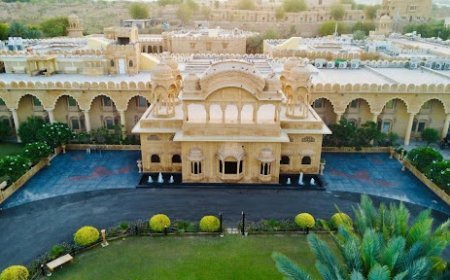
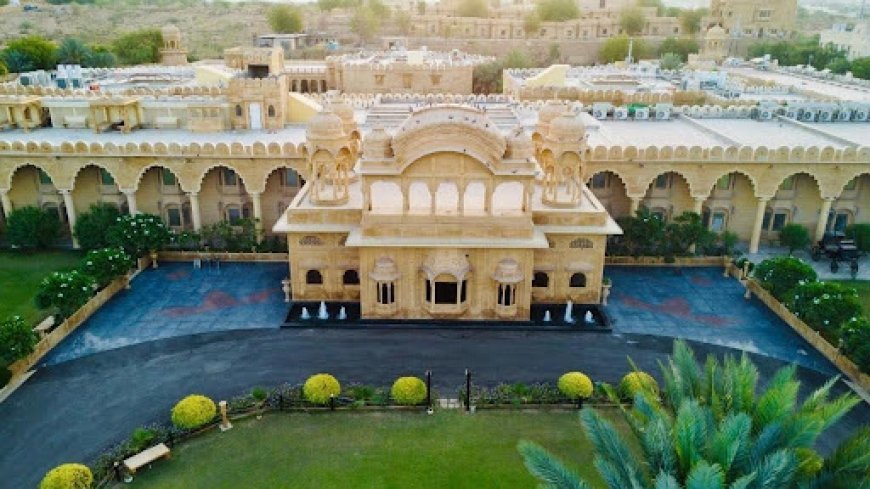
For a proper luxury stay in Jaisalmer, Fort Rajwada is a palace hotel in Jaisalmer spread over six acres on the city outskirts, built in the style of a Rajputana fortress. It’s the kind of place where you walk through carved sandstone corridors to get to breakfast, and the pool has fort views. The property has also become one of the most sought-after venues for destination weddings in Jaisalmer — the golden sandstone backdrop photographs like nothing else, and the six distinct event spaces handle everything from intimate ceremonies to 500-guest celebrations.
Stay for: Three nights. One day for the fort and havelis. One day for Kuldhara and Khuri. One day for doing absolutely nothing by the pool while the desert sun does its thing.
Getting there: Direct flights from Delhi, Mumbai, and Jaipur. Also connected by overnight train from Jodhpur (5–6 hours) and Delhi (12 hours on the Delhi-Jaisalmer Express).
Pro tip: If you’re visiting between October and March, book your stay well in advance. Properties like Fort Rajwada fill up quickly during peak season, especially around wedding dates and the Jaisalmer Desert Festival in February.
4. Kumbhalgarh — The Wall That Should Be World-Famous
Here’s a fact that will genuinely surprise you: Kumbhalgarh Fort has a wall that runs 36 kilometres around its perimeter. It’s the second-longest continuous wall in the world after the Great Wall of China. And almost nobody outside Rajasthan has heard of it.
The fort sits in the Aravalli hills between Udaipur and Jodhpur, surrounded by thick forest. Maharana Pratap — arguably Rajasthan’s most revered historical figure — was born here. Inside the walls, there are over 360 temples, palace ruins, gardens, and reservoirs. On clear days, you can see Udaipur’s distant lake from the uppermost ramparts.
What makes Kumbhalgarh special isn’t just the scale. It’s the emptiness. You can walk for 20 minutes along the fort wall without seeing another person. Birds call from the jungle below. The wind carries the smell of dry grass and wildflowers. It feels ancient in a way that busy, well-maintained monuments like Amer Fort in Jaipur simply can’t.
The surrounding Kumbhalgarh Wildlife Sanctuary is home to wolves, sloth bears, and jungle cats, though sightings require patience and luck. The scenery alone — hilly green forest that looks nothing like the stereotypical Rajasthan desert — is worth the drive.
Stay for: One night is workable if you’re short on time. Two is better — combine it with a visit to Ranakpur Jain Temple, which is only 50 kilometres away and houses 1,444 individually carved marble pillars. Each one different from the next.
Getting there: About 3 hours north of Udaipur by road, or 3.5 hours southeast of Jodhpur. No direct rail — drive is the only practical option.
5. Bikaner — The City That Doesn’t Care If You Visit
That’s not a criticism. It’s a compliment. Bikaner is one of the few major Rajasthani cities that hasn’t reshaped itself around tourism. The old town functions the way it always has. Shopkeepers sell to locals. Cafés serve chai in clay cups without English menus. Cows still own the right of way.
Junagarh Fort is the city’s anchor — a stunning red sandstone complex built in the 1500s that never fell to invaders. Unlike most Rajasthan forts built on hilltops, Junagarh sits at ground level in the middle of the city. Its interiors are extraordinary: rooms covered floor to ceiling in gold leaf, inlaid mirrors, delicate lattice screens, and painted ceilings that rival anything in Jaipur’s City Palace. And you’ll share them with maybe ten other visitors on a busy day.
Bikaner is also quietly one of Rajasthan’s best food cities. Kachori from the street stalls near Kote Gate is legendary — crispy, spiced, and served with tamarind chutney that makes you consider moving here permanently. The Bikaneri bhujia (spiced gram flour snack) is exported across India, but tasting it fresh from the source is a different experience entirely.
For something genuinely unusual, the Karni Mata Temple in Deshnoke (30 km outside the city) is home to an estimated 20,000 rats that are worshipped as sacred. It’s bizarre, fascinating, and unlike anything else in India. Whether you enter is entirely up to your comfort level.
Stay for: Two nights. One full day for Junagarh Fort and the old city. Half a day for Deshnoke. The rest for eating your way through the street food scene.
Getting there: Excellent train connections from Delhi (6–8 hours), Jaipur (6 hours), and Jodhpur (5 hours). Also connects to Jaisalmer by rail, making a Bikaner-Jaisalmer-Jodhpur triangle very doable.
The Point of All This
Rajasthan rewards the people who go deeper. The big cities are big cities for a reason — they’re stunning, well-organised, and deliver exactly what the brochures promise. Nobody’s telling you to skip them.
But if your last Rajasthan trip felt like it was missing something — some rawness, some surprise, some moment where you turned a corner and genuinely didn’t know what you’d find — these five places will fix that.
Take the slower route. Stay the extra night. Eat where there’s no menu in English. That’s where the real Rajasthan is hiding, and it’s not going to wait forever.
What's Your Reaction?
 Like
0
Like
0
 Dislike
0
Dislike
0
 Love
0
Love
0
 Funny
0
Funny
0
 Angry
0
Angry
0
 Sad
0
Sad
0
 Wow
0
Wow
0