











































Allahabad High Court: Illegal Police Detention Violates Fundamental Right to Liberty

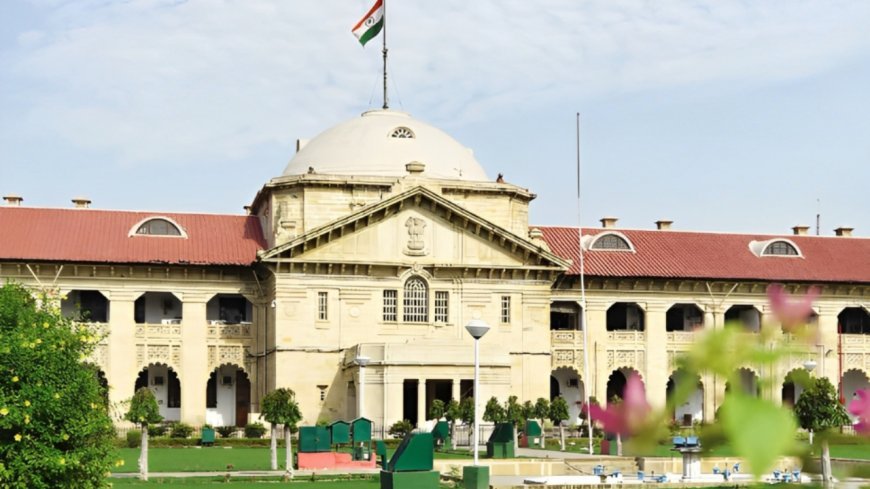
In a significant judgment reinforcing constitutional protections against police excesses, the Allahabad High Court has ruled that illegal detention by police is a direct violation of the fundamental right to life and personal liberty guaranteed under Article 21 of the Constitution. The court also held that preventive proceedings under Section 107/116 of the Code of Criminal Procedure (CrPC) cannot be misused to justify unlawful police action in domestic disputes.
The ruling came in the case of Matambar Mishra vs State of Uttar Pradesh and Others, decided on May 29, 2026, by a Division Bench comprising Justice J.J. Munir and Justice Sanjiv Kumar.
The court ordered the Uttar Pradesh government to pay the petitioner, Matambar Mishra, ₹25,000 as ad hoc compensation and ₹10,000 as litigation costs for his illegal detention. Significantly, the state was granted liberty to recover the amount from the salary or other dues of the police officer found responsible.
According to the petitioner, he was staying at his native village in Prayagraj district on November 26, 2022, when Surya Prakash Dubey, then in-charge of Baraut police outpost, allegedly entered his home, dragged him out without explanation and took him to the police station. Mishra claimed he was confined in the lock-up at Handia police station for nearly 24 hours, from November 26 to November 27, without any legal authority.
The petitioner further alleged that during his detention, the police officer demanded a bribe of ₹20,000 for his release. Though the High Court did not examine the bribery allegations in detail, it noted that such accusations could be investigated separately by disciplinary or anti-corruption authorities.
The state attempted to justify the police action by referring to proceedings initiated under Section 107/116 CrPC, which deals with preventive measures to maintain public peace. However, the court found that the dispute originated from a complaint of domestic violence made by the petitioner’s daughter-in-law.
The Bench observed that proceedings under Section 107/116 are intended to preserve public order and tranquillity and cannot be invoked in purely domestic or matrimonial disputes. The judges emphasized that the police had little role to play unless a cognizable offence had been committed.
The court noted that there was no clear denial by the police that the petitioner had been brought to the station. Instead, the authorities claimed that the parties had voluntarily appeared and settled their dispute. Rejecting this explanation, the court remarked that it was unrealistic to believe that a person accused in a domestic dispute would voluntarily visit a police station to negotiate a settlement in the presence of a police officer.
Justice Munir observed that a police officer is not a mediator, community leader or arbitrator to whom family members would willingly submit their disputes. The court concluded that the petitioner had indeed been forcibly taken into custody and unlawfully confined.
The judgment strongly criticised the misuse of preventive proceedings as a cover-up for illegal detention. It held that the proceedings initiated under Section 107/116 CrPC were subsequently used to create an appearance of legality after the petitioner had already been detained without authority.
The Bench described the violation as an attack on the “most fundamental essence” of the constitutional guarantee of liberty. It held that the police officer had acted recklessly by detaining the petitioner despite having no legal authority to do so.
While the petitioner had initially sought only an independent inquiry into the conduct of the police officer, the High Court decided that such relief would not adequately remedy the violation of his constitutional rights. Invoking its powers under writ jurisdiction, the court held that it could grant appropriate relief even if compensation had not been specifically sought in the petition.
The judges relied on Supreme Court precedent affirming that constitutional courts have the power to mould relief to ensure complete justice in cases involving violation of fundamental rights.
The court also made broader observations on police accountability, noting that many officials continue to believe that violations of citizens’ rights will go unchallenged because only a small number of victims approach courts for redress. It stressed that whenever a citizen does seek judicial intervention, courts have a duty to enforce constitutional guarantees and hold public officials accountable.
Consequently, the High Court directed the state government to pay compensation and costs to the petitioner within 30 days. It also permitted the government to recover the amount from the erring police officer. The court clarified that the compensation awarded was only ad hoc in nature and that the petitioner remained free to file a civil suit seeking additional damages for his illegal detention.
The judgment serves as a strong reminder that police powers are subject to constitutional limits and that unlawful detention, even for a short duration, constitutes a serious infringement of personal liberty. It also sends a clear message that officers responsible for such violations may ultimately be held personally accountable for the consequences of their actions.
*Sanjeev Sirohi, Advocate is based in Meerut, UP
What's Your Reaction?
 Like
0
Like
0
 Dislike
0
Dislike
0
 Love
0
Love
0
 Funny
0
Funny
0
 Angry
0
Angry
0
 Sad
0
Sad
0
 Wow
0
Wow
0