

























The Cockroach Movement: Shadow of Gandhism or New Resistance for the Digital Age?

- Dr. Priyanka Saurabh
Whenever a new mass movement emerges in India, attempts are made to understand it within old ideological frameworks. This is precisely what happened with the Cockroach Movement. Some see it as a new expression of youth discontent, while others attempt to readit within the shadow of the Gandhian tradition. But the question is: can this movement truly be linked to the relevance of Mahatma Gandhi, or is this merely a catchy but superficial comparison?
The answer to this question is neither a complete "yes" nor a complete "no." The Cockroach Movement certainly reflects some elements of Gandhian politics, but its nature, language, medium, and ideological structure are clearly distinct from Gandhism. Therefore,before considering it a direct extension of Gandhi's tradition, it is essential to understand its nature and limitations.
The greatest strength of Gandhian politics was its moral discipline. Truth, non-violence, self-restraint, public service, and constructive programs—these were not merely political slogans, but the soul of the movement. For Gandhi, the objective of strugglewas not merely a change of power, but also a process of moral transformation of the individual and society. This is why his movement demonstrates a profound harmony between means and ends.
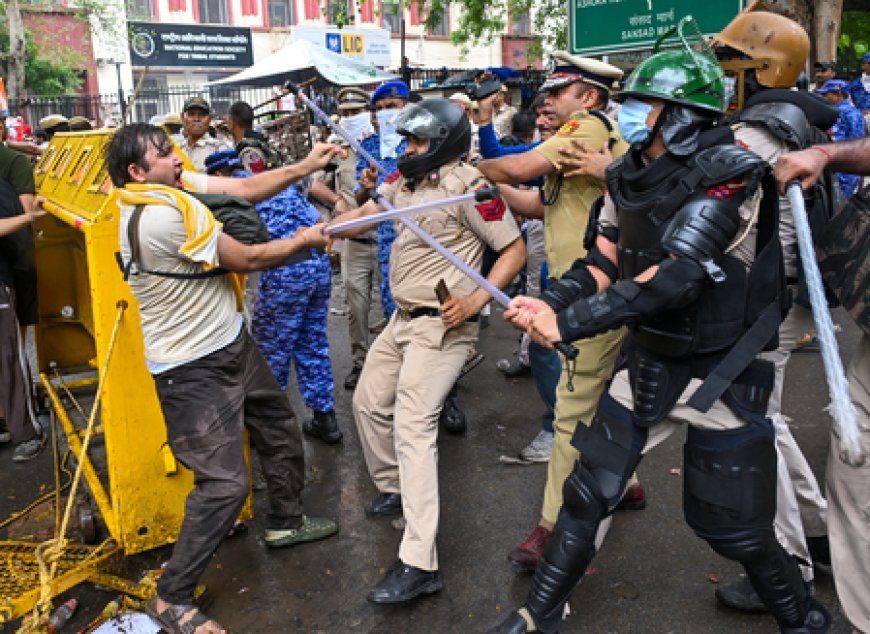
In contrast, the power of the Cockroach Movement lies in its satire, symbolism, and digital activism. It has emerged at a time when a new generation is distancing itself from traditional political languages and registering its dissent through social media,memes, digital campaigns, and public demonstrations. This movement demonstrates that today's youth seek to express their discontent through new cultural symbols and communication channels, rather than through old political structures. In this sense, it representsa new form of contemporary resistance, not a reiteration of traditional Satyagraha.
Nevertheless, its connection to the Gandhian context cannot be completely denied. Gandhiji placed the ordinary citizen at the center of politics. He instilled the belief that the real power for change lies in the consciousness, labor, and moral courage of thepeople. The Cockroach Movement is also significant in that it brought issues such as youth unemployment, the credibility of the examination system, institutional accountability, and growing distrust of governance to the center of public discourse. At thislevel, it generated the same energy of public participation that is considered the core element of Gandhian politics.
But this is where the most important difference emerges. For Gandhi, the purity of means was paramount. He believed that righteous ends could not be achieved through unrighteous means. On the other hand, the Cockroach Movement's tone is more sharp, satirical,and immediate. It challenges the establishment, but does not emphasize self-discipline, self-confidence, and ideological restraint as Gandhi did. Its language is one of resistance, not of asceticism. Therefore, calling it a complete Gandhian obscures its uniqueidentity.
It should also be remembered that Gandhism was not merely a politics of protest. It encompassed the broader concept of village self-rule, swadeshi, dignity of labor, social harmony, communal harmony, and constructive nation-building. In contrast, the currentfocus of the Cockroach Movement appears to be limited primarily to education, employment, youth aspirations, and institutional accountability. Therefore, it would be premature to call it a comprehensive social project like Gandhism.
Yet, there is a profound similarity between the two—both break the silence of the masses. Gandhi taught ordinary Indians to speak out against colonial rule. Today's movement reassures young people that discontent isn't merely personal frustration; it can alsobe given democratic expression. When youth issues are voiced through digital platforms, public demonstrations, and social dialogue, it signals the vitality of democracy. Politics hasn't ended; it has simply found new mediums and new symbols.
Therefore, Gandhi's relevance here is less important as a direct inspiration and more as a moral criterion. The question should not be whether the Cockroach Movement is Gandhian or not; rather, whether it awakens the moral consciousness of the people. Is itmerely a momentary outburst of discontent or is it preparing the ground for some long-term social change? Will its satirical power translate into democratic reforms?
Time will provide answers to these questions. For now, it can certainly be said that linking this movement to Gandhiji is partially justified if we view it in the context of public participation, civil dissent, and the demand for accountability. However, whenjudged against the criteria of satyagraha, nonviolence, self-restraint, and moral reconstruction, it appears distinct from Gandhism. It is not a successor to Gandhi, but a representative of the new protest culture of the digital age.
In conclusion, any mass movement should be evaluated not just by its symbols or popularity, but by its purpose, means, ethics, and long-term impact. If a movement awakens the public, demands accountability from power, and strengthens democratic participation,it certainly touches upon some elements of the Gandhian legacy. However, if it lacks truth, non-violence, self-discipline, and a broader vision of constructive social change, it would not be appropriate to call it an extension of Gandhism. Therefore, it wouldbe more appropriate to understand the so-called "cockroach movement" not as a rebirth of Gandhism, but as a new protest culture of the digital age. History will ultimately decide whether it was a momentary discontent or a lasting chapter in democratic consciousness.
(Dr. Priyanka Saurabh, PhD (Political Science), is a poet and social thinker.)
What's Your Reaction?
 Like
0
Like
0
 Dislike
0
Dislike
0
 Love
0
Love
0
 Funny
0
Funny
0
 Angry
0
Angry
0
 Sad
0
Sad
0
 Wow
0
Wow
0